


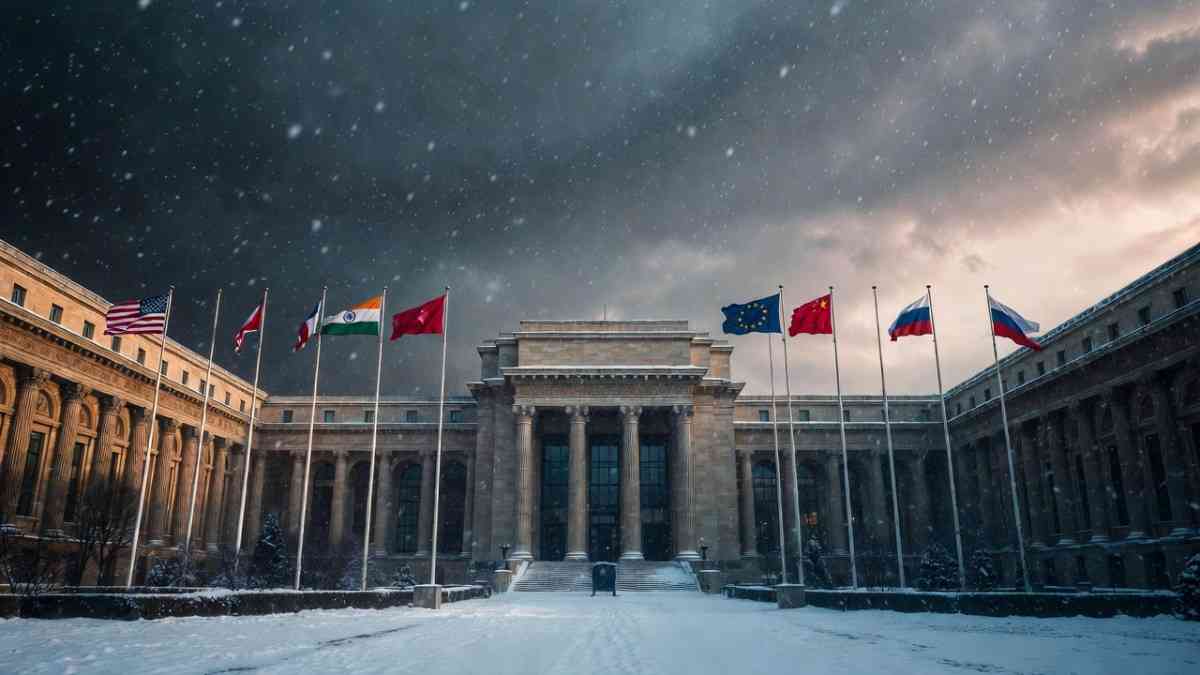
The grey winter waters of Lake Geneva have long reflected the shifting moods of history, but rarely has the reflection been this dark. As snow flurries dusted the manicured lawns of the Palais des Nations this morning, the mood inside the historic complex was not one of hope, but of grim necessity.
Today marks the opening of the 2026 Global Security Framework Summit, a diplomatic gathering that many analysts are calling the most significant since the end of the Cold War. With three major regional conflicts currently destabilizing global markets and cyber-warfare reaching unprecedented levels, the delegations arriving in Geneva carry the weight of a precarious world order in their briefcases.
The city is in lockdown. The iconic Jet d’Eau fountain struggles against a biting wind, while armored limousines clog the Quai Wilson. Snipers are positioned on the rooftops of the grand hotels lining the lakeshore—the President Wilson, the Beau-Rivage—where the delegations from the United States, the European Union, China, Russia, and India have set up their temporary headquarters.
We are five minutes to midnight, said António Guterres, the UN Secretary-General, in a somber opening address. Geneva has always been the city where the world comes to pull back from the brink. We must ensure that history does not record this week as the moment we stepped over it.”
The Anatomy of the Crisis: Why Geneva? Why Now?
To understand why 5,000 journalists and diplomats have descended on this quiet Swiss city, one must look at the chaotic trajectory of the last twelve months. The fragile stability of 2025 collapsed under the weight of what historians are already terming the “Great Fragmentation.”
The primary driver of these talks is the escalating standoff in Eastern Europe, which has now bled into a broader proxy conflict involving drone warfare and economic blockades. What began as a territorial dispute has metastasized into a contest of endurance between the Western Alliance and the Eastern Coalition. Supply chains have been severed, energy prices in Europe have tripled, and a refugee crisis of historic proportions has strained the social fabric of the continent.
However, the “Geneva 2026” agenda goes beyond borders. It is about the rules of the game. The rapid deployment of autonomous AI weaponry and the recent “Blackout Tuesday” cyber-attack—which temporarily crippled banking systems across three continents in January—have terrified global leaders. There are no treaties governing these new weapons. The rulebook has been burned, and Geneva is the desperate attempt to write a new one.
The Players and Their Strategies
The dynamics inside the negotiation rooms are reported to be frosty. Sources close to the talks describe the seating arrangements alone as a “logistical nightmare,” with protocol officers spending three days ensuring that adversarial delegations would not cross paths in the hallways.
1. The Western Bloc (US & EU)
Led by the U.S. Secretary of State and the EU High Representative, the Western position is clear but difficult to enforce. They are demanding an immediate cessation of cyber-hostilities and a return to the 2022 territorial baselines. However, political fatigue at home is a major vulnerability. With elections looming in several key Western democracies later this year, leaders need a win. They cannot afford a prolonged stalemate, but they also cannot afford to look weak.
2. The Eastern Coalition
The delegations representing the opposing interests feel the wind is at their backs. Having weathered the worst of the economic sanctions, they are arriving in Geneva not to capitulate, but to renegotiate the global hierarchy. Their demand is a “New Security Architecture”—essentially, a sphere of influence that pushes Western military infrastructure back.
3. India and the Global South
Perhaps the most interesting dynamic in 2026 is the assertiveness of the non-aligned bloc. Representatives from India, Brazil, and South Africa are present not just as observers, but as power brokers. India, led by External Affairs Minister Dr. S. Jaishankar’s team, is pushing a separate agenda focused on “Digital Sovereignty” and food security. India has refused to pick sides, arguing that the conflict is a “failure of Northern Hemisphere leadership” and that the developing world should not pay the price for it.
Sahi Update Analysis: India’s role here is critical. If India can mediate a ceasefire on the economic front (lifting blockades on grain and oil), it will cement its position as a true global superpower (Vishwaguru).
The New Threat: AI and Cyber Warfare
Unlike the summits of the 20th century, which focused on tanks and missiles, the 2026 Geneva Summit is obsessed with code. The recent rise of Autonomous Lethal Weapons Systems (LAWS) has changed the face of war.
“The old treaties are dead,” says Dr. Elena Kogan, a senior fellow at the Geneva Centre for Security Policy. “The START treaties, the conventional forces agreements—they belong to a different century. The diplomats here aren’t just trying to stop a war; they are trying to invent a new language for peace in the digital age. How do you verify that a country has turned off a cyber-weapon? You can’t see it with a satellite.”
Key Agenda Items on AI:
- The “Kill Switch” Protocol: A proposed agreement that all AI weapons must have a human override.
- Infrastructure Immunity: A global ban on targeting civilian power grids, hospitals, and water systems with cyber-attacks.
- Space Security: Preventing the weaponization of low-earth orbit satellites, which are essential for GPS and internet.
The Economic Stakes: What This Means for You
While the diplomats talk in closed rooms, the impact of their success or failure will be felt in every household, from New Delhi to New York. The global economy is currently holding its breath.
1. Oil and Energy Prices The uncertainty has pushed crude oil prices to volatile levels. If the talks fail, analysts predict oil could hit $120 per barrel within weeks. This would lead to a spike in petrol and diesel prices in India, increasing the cost of vegetables, transport, and daily goods.
- Good News: If a deal is signed, prices could crash back down to $70, bringing massive relief to the Indian middle class.
2. Gold and Safe Havens Investors are nervous. Gold prices have hit historic highs as people rush to protect their money. The “Sahi Update” financial team advises keeping a close watch on the summit’s outcome before making large investments in the stock market this week.
3. Jobs and Visas For Indian students and IT professionals, the summit is crucial. The proposed “Digital Borders” act being discussed could limit the movement of data and skilled workers between East and West. A positive outcome in Geneva ensures that the global IT sector remains open and connected.
Inside the Room: The “Ghost of 1985”
Veterans of Geneva diplomacy cannot help but draw parallels to the 1985 summit between Ronald Reagan and Mikhail Gorbachev. That summit did not produce immediate treaties, but it broke the psychological ice of the Cold War. It introduced the human element into a relationship defined by nuclear mathematics.
“The chemistry is missing this time,” notes a retired US ambassador covering the talks for a major network. “In ’85, there was a mutual respect, a shared fear of nuclear winter. Today, the fear is there, but the respect is gone. The leaders view each other not as rivals, but as existential threats. The rhetoric has been so poisonous for so long that it’s hard to walk it back.”
Furthermore, the media landscape of 2026 complicates everything. In 1985, leaders could talk in private. Today, every grimace, every handshake (or lack thereof), and every leaked draft is instantly analyzed by millions on social media. The “echo chamber” effect means that compromising in Geneva can look like treason back home.
The Humanitarian Reality
A few kilometers from the luxury hotels, outside the UNHCR (UN Refugee Agency) headquarters, protestors have gathered. They are a diverse crowd: mothers from conflict zones, climate activists, and students. They hold banners reading: “While You Talk, We Die” and “2026: The Year of Peace?”
The humanitarian statistics released this morning are staggering. The conflict zones have seen a 40% rise in displaced persons in the last six months. Food inflation in parts of Africa and the Middle East—reliant on grain from the contested regions—has pushed 30 million people to the brink of famine.
“This is not an academic exercise,” says Dr. Ayesha Malik of Doctors Without Borders. “We are seeing a collapse of the Geneva Conventions on the battlefield. Hospitals are being targeted. Aid convoys are being blocked. If this summit fails, we are looking at a humanitarian catastrophe that the UN has no funds to manage.”
Conclusion: Three Possible Outcomes
As the first day of talks concludes, Sahi Update analysts are gaming out three possible scenarios:
- The Breakthrough (10% Chance): A comprehensive peace treaty is signed. This is unlikely given the deep mistrust.
- The Collapse (30% Chance): One side walks out. This would lead to an immediate crash in global stock markets and a spike in military tensions.
- The Freeze (60% Chance): The most likely outcome. No permanent peace, but a “ceasefire agreement” to stop the fighting for now and continue talking. This would stabilize the economy but leave the core issues unresolved.
For the next 72 hours, the future of the 21st century is being negotiated in a few warm rooms by a cold lake. The world is watching.
Stay tuned to Sahi Update for hour-by-hour coverage of the Geneva Summit.