


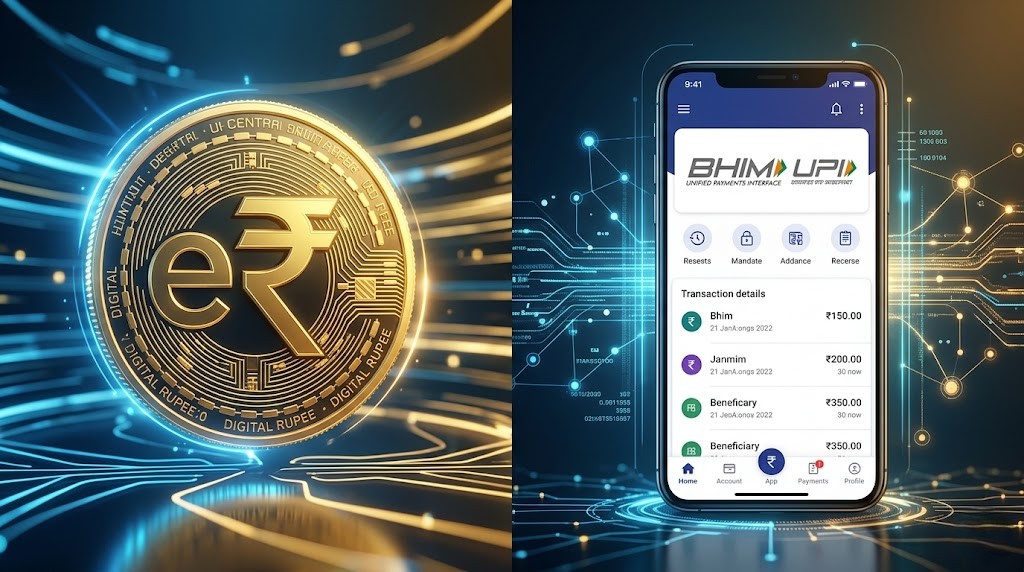





Financial Evolution 2026
The Indian economy is currently at the forefront of the global digital finance revolution. For nearly a decade, UPI has been the undisputed king of peer-to-peer and peer-to-merchant payments. However, the introduction of the Central Bank Digital Currency (CBDC) has sparked a new debate: Digital Rupee vs UPI Comparison 2026. Many users are often confused, thinking both are the same because they both involve scanning a QR code. But underneath the surface, they are as different as a bank cheque and a physical 500-rupee note.
As the Reserve Bank of India (RBI) expands the use cases of the e-Rupee, understanding the Digital Rupee vs UPI Comparison 2026 is no longer just for tech enthusiasts—it is essential for every citizen. Whether you are a small business owner or a tech-savvy student, knowing the privacy, speed, and reliability of these two systems will define your financial security. This 1600+ word comprehensive guide is designed to clarify the myths and provide a roadmap for the future of money in India.
Master Your Digital Wallet!
Get the most accurate insights on Digital Rupee, UPI, and Modern Banking Rules.
Visit SahiUpdate Home🏦 Architecture: Money vs Payment System
The primary point in any Digital Rupee vs UPI Comparison 2026 is the fundamental nature of the asset. UPI is a Payment Interface. When you pay via UPI, money moves from your Bank Account A to Merchant Bank Account B. It is essentially a digital instruction to your bank to transfer a balance. If the bank server is down, the transaction fails.
On the other hand, the Digital Rupee (e₹) is Money itself. It is a digital token that represents a liability of the RBI. Just like the cash in your physical wallet doesn’t need a bank to be “transferred” to someone else, the Digital Rupee moves from one digital wallet to another without hitting the core banking system of a commercial bank. This makes the Digital Rupee vs UPI Comparison 2026 a choice between a third-party service (UPI) and a direct sovereign asset (CBDC).
Don’t Miss: Understanding the New RBI Banking Rules for April 2026 to stay safe from digital frauds.
🔒 Anonymity and Privacy: The Cash Experience
One major advantage often highlighted in the Digital Rupee vs UPI Comparison 2026 is privacy. Every UPI transaction you make appears on your bank statement. If you buy a cup of coffee for ₹20, it is recorded. If you make 50 such transactions, your bank statement becomes cluttered. For those who value financial privacy, this is a drawback.
The Digital Rupee is designed to mirror the anonymity of physical cash. For small-value transactions, the RBI has suggested that the e-Rupee will offer a degree of privacy where the transaction isn’t necessarily tracked by the commercial bank. In the Digital Rupee vs UPI Comparison 2026, the CBDC wins for users who want a cleaner bank statement and a more “cash-like” digital experience.
🚫
No Intermediary Risk
In the Digital Rupee vs UPI Comparison 2026, the e-Rupee eliminates ‘Settlement Risk.’ Since the digital token itself is the value, the transaction is final and settled the moment it reaches the recipient’s wallet, unlike UPI which relies on bank settlement cycles.
📊 Transaction Limits and Daily Usage
Transaction limits play a huge role in the Digital Rupee vs UPI Comparison 2026. UPI has standard daily limits (usually ₹1 Lakh to ₹5 Lakh depending on the category). However, since the Digital Rupee is essentially cash, the limits are governed by the same rules that apply to physical cash transactions. Large transfers of e-Rupee might require the same reporting as large cash deposits under Income Tax laws.
For the average consumer, UPI remains the most convenient for small, quick QR scans. But for high-value B2B transactions, the Digital Rupee vs UPI Comparison 2026 shifts in favor of CBDC due to its “finality of settlement,” meaning the money is considered “received” instantly without any chance of a bank-side reversal later on.
Security Tip: Before making large payments, check the New Digital Payment Security Guidelines effective from 1 April.
🌐 Offline Capabilities: Payments Without Internet
The most exciting part of the Digital Rupee vs UPI Comparison 2026 is the “Offline” feature. UPI generally requires an active internet connection (though UPI Lite and USSD exist, they have limitations). The Digital Rupee is being built with native offline capabilities. This means you can tap your phone to another phone and transfer e-Rupee even in a basement or a remote village with zero network coverage.
This feature makes the Digital Rupee a superior choice for rural India and emergency situations. In the Digital Rupee vs UPI Comparison 2026, the e-Rupee is the clear winner for true digital inclusion, as it doesn’t depend on the availability of 5G or Wi-Fi to function as a medium of exchange.
⚡ Trending: Next-Gen Tech Guides
Visit SahiUpdate →
📅 The Future: Interoperability in 2026
The RBI has already started making the two systems work together. In the Digital Rupee vs UPI Comparison 2026, the keyword is “Interoperability.” You can now scan a standard UPI QR code using your Digital Rupee app. This means you don’t need a separate QR code for e-Rupee. This bridge between the two systems ensures that the user doesn’t have to choose one over the other; instead, they can use both depending on their preference for privacy or bank-linking.
Final Conclusion: Which Should You Use?
Conclusion: The Digital Rupee vs UPI Comparison 2026 doesn’t have a single winner because they serve different purposes. UPI is perfect for your day-to-day linked transactions where you want a full record in your bank statement. The Digital Rupee is ideal for those who want cash-like privacy, offline payments, and the security of a sovereign currency that doesn’t rely on bank servers.
As we head deeper into 2026, we recommend keeping both. Use UPI for your regular bills and e-Rupee for your “Digital Pocket Money.” For more deep-dives into the world of finance and technology, stay tuned to the SahiUpdate portal.
❤️ SahiUpdate Helping Hands
Your small support changes lives. Donate ₹10 to ensure digital literacy and internet access for orphaned children across India.
Donate ₹10 Securely

Leave a Comment