


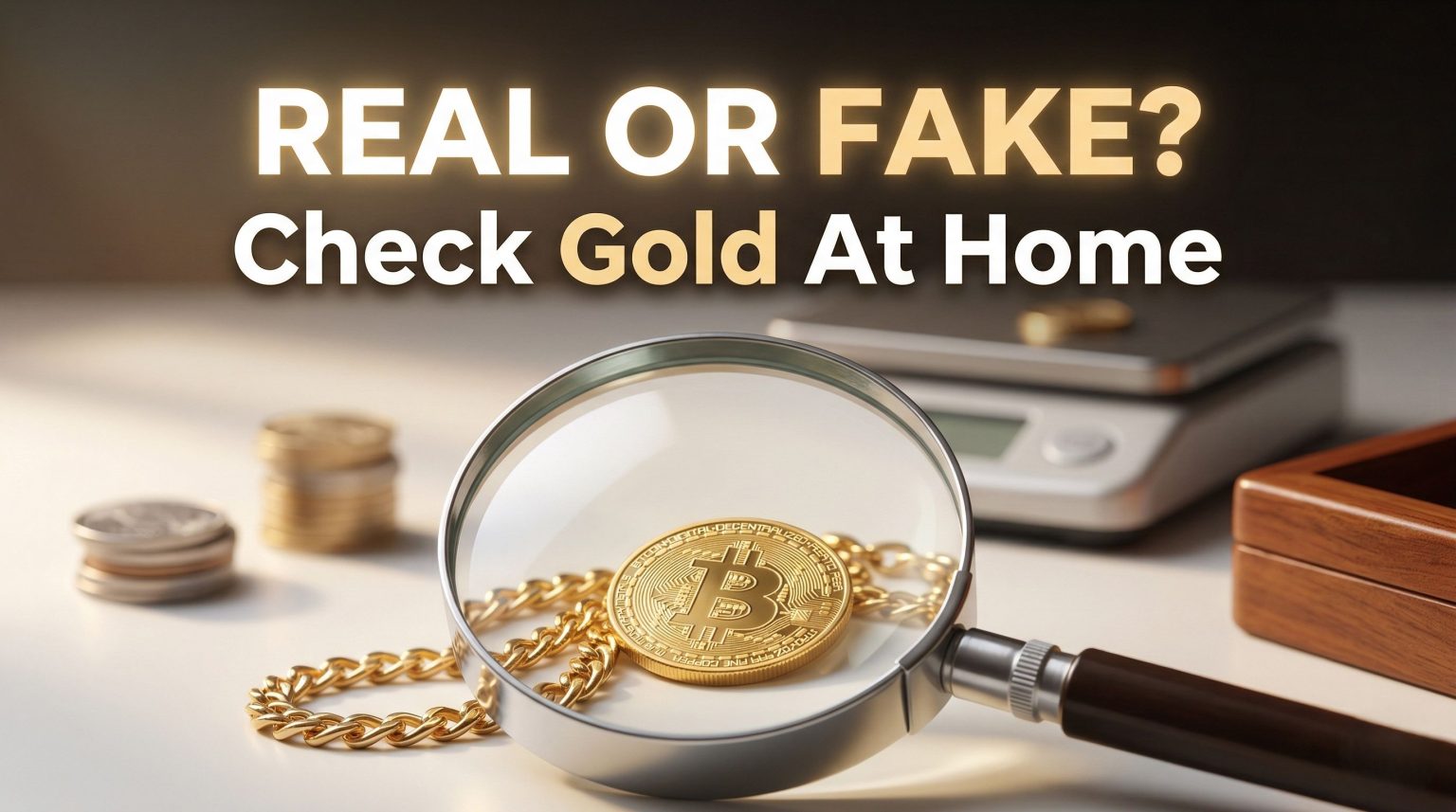





How to Check Real Gold at Home: Buying gold in India is more than just a simple purchase; it is a massive tradition and the ultimate safety net for middle-class families. Parents start saving up for their daughter’s wedding jewelry years in advance. In fact, many parents open a Sukanya Samriddhi Yojana account early on, just so they can buy pure gold when she grows up. But what happens if the jewelry you spent your life savings on turns out to be fake?
Scammers are getting incredibly smart these days. They mix heavy metals like copper or brass and just give it a nice golden polish. It looks heavy, shines bright, but has absolutely no real value. You might have seen movies where the Richest Indian Actors bite into a gold coin to test its purity. While biting works in movies, we have much better, smarter, and safer ways to do it today. Let me walk you through 5 easy home tests to spot fake gold in seconds.
1. The Most Trusted Way: The BIS Hallmark Check
Before you try any water or acid tricks, simply look closely at the jewelry itself. The Government of India has made it mandatory to sell gold with a proper hallmark. Grab a magnifying glass (or use your phone’s macro camera) and look for three specific marks stamped on the inner side of the ring or chain:
- The BIS Logo: A small triangle shape representing the Bureau of Indian Standards.
- Purity Grade: You will see numbers like ’22K916′ (which means 22 Karat or 91.6% pure gold), ’18K750′ (18 Karat), or ’14K585′.
- 6-Digit HUID Code: This is a unique alphanumeric code (like ‘A1B2C3’). You can enter this code in the official BIS Care App on your phone to instantly verify who made it and if it is genuine.
You can always read the official hallmarking guidelines on the Official BIS Government Website to stay updated on the latest purity laws.
2. The Water Drop (Float) Test
This is the easiest test you can do right now in your kitchen. Real gold is an extremely dense and heavy metal. It does not float.
- Take a glass or a jug and fill it with regular tap water.
- Gently drop your gold ring or coin into the water.
- The Result: If it is real gold, it will sink straight to the bottom incredibly fast like a heavy stone. If it hovers, floats, or sinks very slowly, it is definitely mixed with cheap, lightweight metals. Real gold will also never rust or change color in water.
3. The Magnet Test
Did you know that real gold is strictly non-magnetic? This means a magnet should have absolutely zero effect on it. However, a normal fridge magnet won’t work for this test. You need a strong ‘Neodymium magnet’ (you can easily buy one online or find it in old hard drives).
Simply bring the strong magnet close to your jewelry. If the necklace or coin jumps up and sticks to the magnet, I have bad news for you—it is fake. It means the item has iron, nickel, or steel hidden inside. Note: Sometimes the tiny clasp (lock) of a real gold chain has a tiny spring inside which might stick, but the main chain should never stick.
Understanding Gold Purity Levels
People often get confused between 24K and 22K. Let’s clear that up with a simple table so you know exactly what you are paying for at the shop:
| Karat (K) | Gold Purity % | What is it used for? |
|---|---|---|
| 24 Karat | 99.9% | Too soft to make jewelry. Used only for making pure gold coins and investment bars. |
| 22 Karat (916) | 91.6% | The standard for Indian wedding jewelry. Mixed with a little copper/zinc to make it strong. |
| 18 Karat (750) | 75.0% | Mostly used for diamond jewelry and daily-wear rings because it is very hard and durable. |
4. The Vinegar Test
This is a fantastic chemical test that does not ruin your item if it is genuine. Take a few drops of white vinegar (the one you use for cooking) and put it directly on your gold jewelry. Wait for about 15 minutes.
Real gold does not react to acid or vinegar at all; it will keep shining as usual. But if your item starts changing color—turning black, green, or slightly brown—it is a clear sign that it is fake and the vinegar is reacting with cheap base metals.
A Quick Final Word
While these home tests are great for a quick check, scammers are constantly finding new ways to trick buyers. The absolute best way to check real gold is to buy from a highly trusted, reputed jeweler and always insist on a bill that mentions the HUID code and Karat purity. Don’t fall for heavy discounts from random shops. Your hard-earned money deserves real value. Keep visiting Sahi Update for more simple life hacks, financial tips, and smart general knowledge.
Explore More Premium Guides & General Knowledge:
Richest Indian Actors
Free Solar Panel Yojana
Ujjwala Yojana 2026
Find E-Shram UAN Number
Free Image to PDF Tool
PM Awas Yojana 2026
Sukanya Samriddhi Yojana
Best Scientists in India


Leave a Comment