


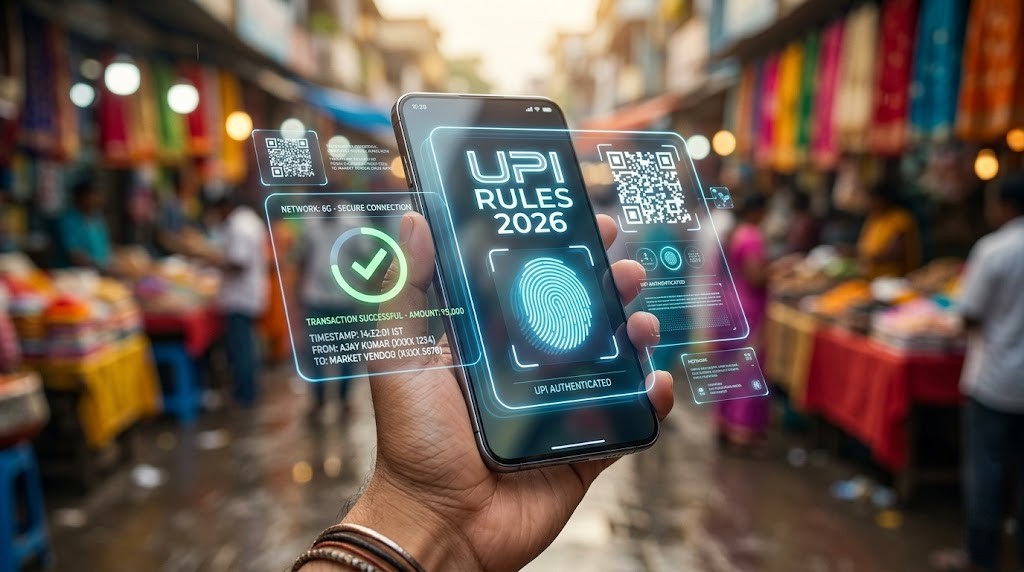





New UPI Payment Rules April 2026: Enhancing Security and Flexibility
The digital payment landscape in India is undergoing its most significant overhaul in years. As of April 22, 2026, the National Payments Corporation of India (NPCI) has officially implemented the UPI Payment Rules update to keep pace with the growing volume of transactions and emerging security threats. Unified Payments Interface (UPI), which has become the backbone of India’s economy, is now evolving to include advanced features like biometric confirmation and revised transaction limits. For every smartphone user, understanding these “Sahi” updates is crucial to ensure smooth daily transactions without hitting technical hurdles or security blocks.
The primary objective of these new UPI Payment Rules is to reduce friction while increasing the safety of high-value transactions. In 2026, UPI is no longer just for small grocery payments; it is being used for stock market investments, insurance premiums, and even property token amounts. To facilitate this, the NPCI has categorized transactions and introduced specific mandates for different sectors. Whether you are a small merchant or a high-frequency digital spender, these guidelines will impact how you authenticate your payments and how much you can transfer in a single day.
Summary of New UPI Payment Rules (2026)
| Feature / Rule | New Update (April 2026) |
|---|---|
| Daily Transaction Limit | Up to ₹2 Lakh for Normal; ₹5 Lakh for Hospitals/Edu |
| Authentication | Mandatory Biometric for transactions above ₹5,000 |
| Credit Line on UPI | Pre-sanctioned credit limit enabled for all major banks |
| Inactive Accounts | Automatic deactivation of IDs inactive for 180 days |
| Transaction Fee | Zero for customers; Merchant MDR revised for high-value |
Biometric Authentication: The 2026 Safety Standard
One of the most talked-about changes in the UPI Payment Rules for 2026 is the introduction of mandatory biometric authentication for high-value transactions. Earlier, a simple 4 or 6-digit PIN was enough for any amount. However, to combat the rise in “PIN-stealing” frauds, the NPCI now requires a fingerprint or face scan for any payment exceeding ₹5,000. This feature uses the hardware-level security of your smartphone, ensuring that the person initiating the payment is physically present. This is a massive step toward making India’s digital ecosystem the most secure in the world.
Revised Transaction Limits for 2026
Recognizing the need for higher liquidity in certain sectors, the new UPI Payment Rules have significantly boosted limits for essential services. For payments made to hospitals, educational institutions, and government tax departments, the daily limit has been raised to ₹5 Lakh. For standard person-to-person (P2P) transfers, the limit remains at ₹1 Lakh to prevent large-scale money laundering. Additionally, a “Cooling Period” of 4 hours has been introduced for the first transaction between two newly linked accounts to prevent instant scam transfers.
Credit Line on UPI: A Game Changer
In 2026, the concept of “Buy Now, Pay Later” has been fully integrated into the UPI ecosystem. Under the new UPI Payment Rules, banks can now offer pre-sanctioned credit lines directly through your favorite UPI app. This means if your bank account has a low balance, you can use your sanctioned credit limit to complete a transaction, which can be paid back as per your bank’s credit cycle. This feature effectively merges the convenience of UPI with the flexibility of a credit card, making it a powerful tool for middle-class consumers managing end-of-month expenses.
Deactivation of Inactive UPI IDs
To keep the system clean and reduce the risk of misuse, the UPI Payment Rules now mandate the automatic deactivation of UPI IDs that have not seen any activity for more than 180 consecutive days. Many users create multiple UPI IDs across different apps (PhonePe, Google Pay, Paytm) and forget about them. These inactive IDs are often vulnerable to hacking or identity theft. If your ID is deactivated, you will need to perform a fresh mobile number verification and re-link your bank account to start using it again.
Impact on Small Merchants and MDR
While UPI remains absolutely free for standard peer-to-peer and small merchant transactions, the UPI Payment Rules of 2026 have introduced a revised Merchant Discount Rate (MDR) for high-value commercial transactions above ₹20,000. This small fee is borne by the merchant and not the customer. This revenue model is designed to support the infrastructure costs of the banks and payment service providers, ensuring that the UPI network remains robust and “Always On” even with billions of monthly hits.
Conclusion
The UPI Payment Rules update for April 2026 is a clear indicator that India’s digital payment journey is moving toward a more mature and secure phase. By integrating biometrics, expanding credit facilities, and tightening the rules for inactive accounts, the NPCI is building a fortress around your digital money. As a user, staying informed about these changes is the best way to leverage the power of technology while staying safe from cyber-frauds. We will continue to track every policy shift and bring you the most “Sahi” and accurate financial news. For more banking tips, UPI guides, and digital safety updates, keep visiting sahiupdate.com. Your digital wallet is now safer than ever!


Leave a Comment