


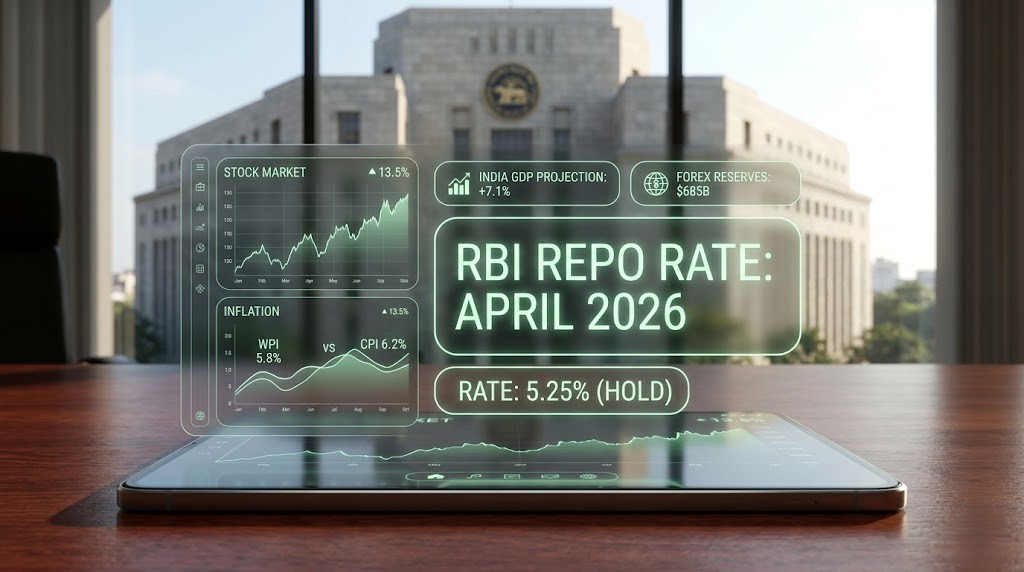





RBI Repo Rate April 2026: Status Quo Maintained at 5.25%
In a move that aligns with market expectations, the Reserve Bank of India (RBI) has decided to keep the key lending rate, or the RBI Repo Rate, unchanged at 5.25% during its first Monetary Policy Committee (MPC) meeting of the new financial year 2026-27. As of April 21, 2026, the central bank’s decision reflects a cautious approach toward balancing economic growth and controlling headline inflation. The “Sahi” news for millions of borrowers is that their Home Loan EMIs are unlikely to see an immediate hike, providing some relief in a volatile global economic environment. However, the RBI has maintained its “neutral” stance, suggesting that future movements will depend heavily on upcoming inflation data.
The decision to maintain the RBI Repo Rate comes amidst a complex interplay of domestic and global factors. While the Indian economy continues to show resilience with a projected GDP growth of 7% for the current fiscal, the rising geopolitical tensions—especially the ongoing Israel-Iran conflict—have put upward pressure on energy and food prices. RBI Governor Shaktikanta Das noted that while core inflation has moderated, the “upside risks” from volatile commodity prices cannot be ignored. For the common man, this means that while interest rates have peaked, the era of low-cost credit is not returning just yet.
Current RBI Policy Rates (April 2026)
| Policy Instrument | Current Rate (%) |
|---|---|
| Repo Rate | 5.25% |
| Reverse Repo Rate | 3.35% |
| Standing Deposit Facility (SDF) | 5.00% |
| Marginal Standing Facility (MSF) | 5.50% |
| Bank Rate | 5.50% |
| Cash Reserve Ratio (CRR) | 4.50% |
Impact on Home Loan and Personal Loan EMIs
For existing and new borrowers, the stability in the RBI Repo Rate is a double-edged sword. Since most retail loans are now linked to the External Benchmark Lending Rate (EBLR), which is primarily the repo rate, your EMIs will remain steady for the next quarter. If you were expecting a cut in interest rates to reduce your monthly burden, you might have to wait until late 2026. Banks are currently maintaining a healthy margin, and unless the RBI officially slashes the rate by at least 25-50 basis points, the cost of borrowing will stay at its current multi-year high level. Experts advise borrowers to continue with their prepayments if they have surplus funds to reduce the long-term interest impact.
What it Means for Fixed Deposit (FD) Investors?
Fixed Deposit investors have been the primary beneficiaries of the steady RBI Repo Rate. In 2026, FD rates across major public and private sector banks are hovering between 6.50% and 7.50%, with Senior Citizens getting even higher returns. Since the RBI has paused the rate, banks are unlikely to increase FD rates further in the short term. In fact, some aggressive private banks and Small Finance Banks might begin to trim their special “high-interest” buckets if liquidity conditions improve. If you are looking to park your surplus savings, locking in your funds at current FD rates is considered a “Sahi” move before any potential downward cycle begins later this year.
Inflation Outlook and Economic Growth
The primary mandate of the RBI is to keep inflation within the target band of 4% (+/- 2%). In 2026, the headline inflation has stayed close to 4.8%, which is within the comfort zone but still higher than the 4% ideal target. The RBI Repo Rate is the primary tool used to suck out excess liquidity from the system to prevent prices from spiraling. The Governor emphasized that the central bank remains “resolute and focused” on aligning inflation with the target. Agriculture growth, supported by a normal monsoon forecast for 2026, is expected to keep food inflation in check, which is a positive sign for the middle-class budget.
Why the RBI Chose a Status Quo?
Several factors influenced the decision to keep the RBI Repo Rate at 5.25%:
- Global Volatility: The uncertainty in the Middle East has led to fluctuations in crude oil prices, which directly impacts India’s import bill.
- Rupee Stability: Maintaining a competitive interest rate helps in keeping the Indian Rupee stable against the US Dollar, preventing imported inflation.
- Strong Credit Growth: Despite high rates, credit demand for automobiles and housing remains strong, indicating that the current rate is not hurting the economy’s growth engine.
- Liquidity Management: The RBI wants to ensure that there is enough money in the banking system for productive sectors without fueling speculative bubbles.
Steps Borrowers Should Take in 2026
- Review Loan Terms: Check if your loan is still on the MCLR regime. If so, consider switching to EBLR (Repo-linked) to benefit from transparency.
- Lock-in FDs: For those seeking safe returns, this is likely the peak of the interest rate cycle. Secure your long-term FDs now.
- Monitor Credit Score: In a high-interest environment, banks offer the best rates only to those with a CIBIL score of 750 or above.
- Avoid Unnecessary Debt: Since the RBI Repo Rate is still relatively high, avoid high-interest personal loans or credit card rollovers.
Conclusion
The RBI Repo Rate update for April 2026 brings a message of “wait and watch.” While the stability in rates is good for the banking system and existing borrowers, the dream of cheaper loans is still a few months away. The RBI’s commitment to price stability ensures that your hard-earned money retains its purchasing power against inflation. As the global economic landscape shifts, we will continue to bring you the most accurate and “Sahi” updates on how these policy changes affect your pocket. For more banking guides, investment tips, and the latest financial news, keep visiting sahiupdate.com. Your financial security is our priority!


Leave a Comment